Farmers in southern Africa reap benefits of conservation agriculture
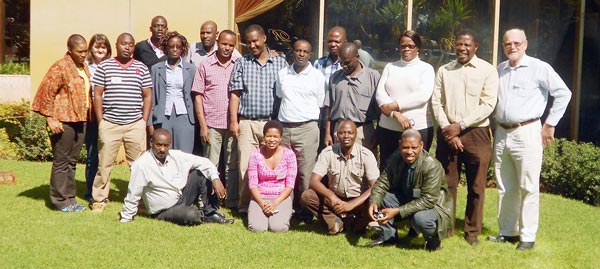
CIMMYT’S Global Conservation Agriculture Program Manager, Irene Christiansen, received a first-hand look at the benefits and challenges of practicing conservation agriculture (CA) in southern Africa during a 9-13 June visit to the region.
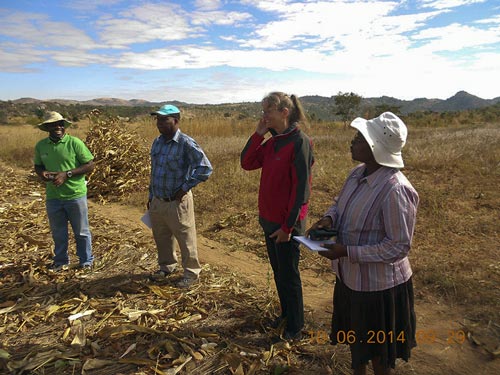
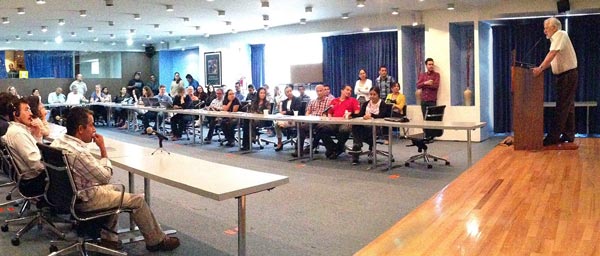
On the first day, she met with scientists in the CIMMYT Southern Africa Regional Office and the country liaison officer, Dr. Mekuria Mulugetta. The scientists gave formal presentations of their key activities and how these are linked to GCAP activities in the region. The remainder of the week was enriched by site visits to project areas and partner meetings.
One of the highlights was a visit to the Integrating Crops and Livestock for Improved Food Security and Livelihoods in Rural Zimbabwe (ZimCLIFS) project, which is funded by the Australian Centre for International Agricultural Research. The project is joined by the International Livestock Research Institute (ILRI), CIMMYT, and the International Crops Research Institute for the Semi-Arid Tropics (ICRISAT).
“Our work under conservation agriculture is focused on three aspects – food, feed and soil fertility management,” explained cropping systems agronomist Isaiah Nyagumbo. Christiansen met farmers who are testing different maize-legume systems, including fodder legumes. “The use of velvet beans and lablab as supplementary feed for livestock during the dry season is proving to be very popular among farmers,” said Irene Chakoma of the International Livestock Research Institute.
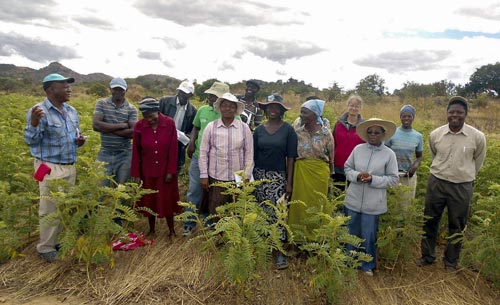
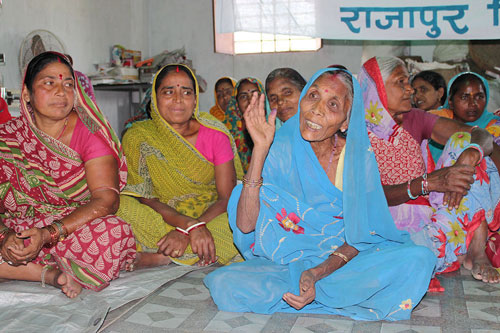
Another group of farmers, who are implementing ZimCLIFS trials in Goromonzi District, said they have benefited from learning new farming techniques such as growing grain and forage legumes for soil fertility improvement, growing crops for fodder and preparing hay bales from forage crops. One challenge they face is keeping maize residue on the fields, a key component of CA. Because of communal grazing, they said, most of the maize residue is eaten by livestock, leaving thatch grass species as the main source of residue for soil cover. “Residue application is the most labordemanding task for us when practicing CA, as it involves fetching grass from our field boundaries and from fields that are farther away,” one said.
To address this challenge, ZimCLIFS is testing the potential of using biomass from unpalatable legumes such as fish bean and common rattlepot. Finding innovative solutions to smallholder farmers’ problems is a key component of the program. “We are also testing the effects of different residue types in CA such as maize residues, grass and leaf litter and their interaction with nitrogen management in trials implemented in the 11 wards across Goromonzi and Murehwa districts,” reported cropping systems agronomist Walter Mupangwa.
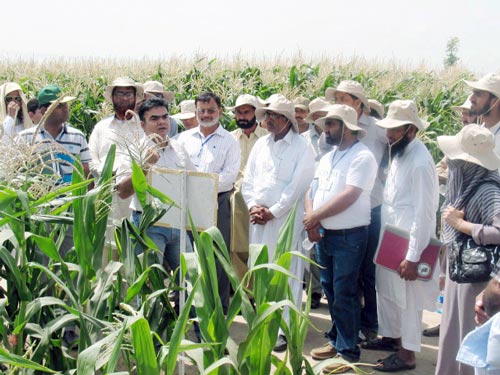
Later in the week Christiansen visited a site near Bindura, Mashonaland Central, where farmers have been implementing CA with a CIMMYT team led by cropping systems agronomist Christian Thierfelder for the last 10 years. Farmers in the Pindukai Valley explained that they stopped using plows in all their operations after realizing the benefits of minimum soil disturbance. Using a direct seeder or ripper allows them to plant their fields in one-quarter of the time it would take to plow the heavy soils.
Farmers also use herbicides for weed control, which makes CA very attractive to them. “We arrived in 1987 at this farm with 16 families and have now grown to 56 families. None of us is currently using a plow except for some tobacco growers,” said farmer Hendrixius Zvamarima during discussions.
Another farmer said the long-term intervention “changed our way of agriculture completely.” Christiansen then enjoyed lunch with farmers in the field, testing local chicken with sadza (maize porridge) and muriwo (rape leaves). Wrap-up discussions with the GCAP team focused on developing new strategies to bridge funding gaps when projects end to ensure continuity with stakeholders. Christiansen added examples from her own experience in Tanzania and stressed the need to involve the private sector in GCAP activities.
The visit was a great success for everybody involved, as Christiansen saw first-hand the work of GCAP scientists in the region, while the scientists used the opportunity to highlight challenges with current funding and support needed in future work.
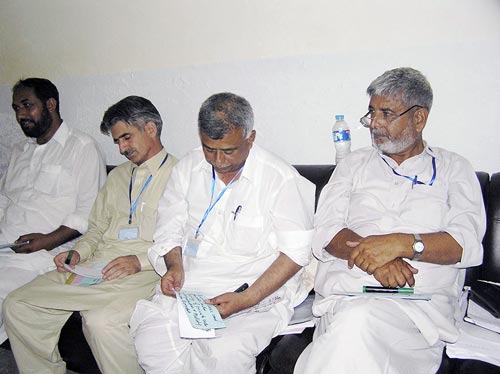
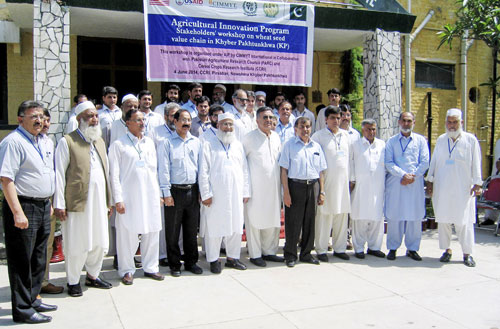 The remaining 93 percent of seed comes from informal sources. The lack of business perspective among almost all the major value chain actors coupled with weak coordination and linkage between them were identified by workshop participants as the main reasons for the predominance of informal seed systems in the province. The prevalence is a concern for wheat growth and sustainability. Farmer Abdul Malik from Swabi stressed that “seed is very important to maximize yield, and unavailability of quality seeds is the main cause of low productivity.”
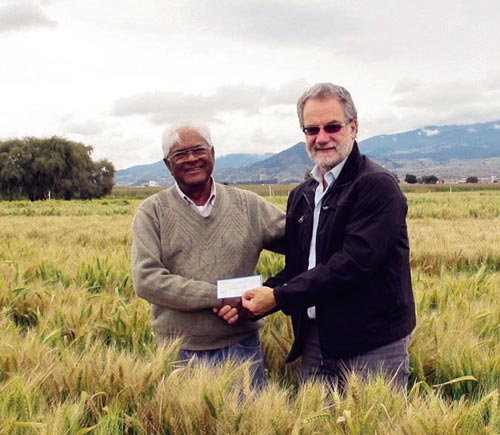
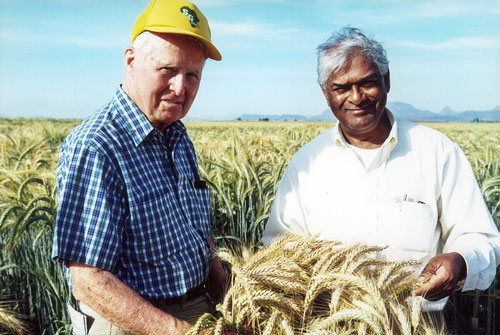
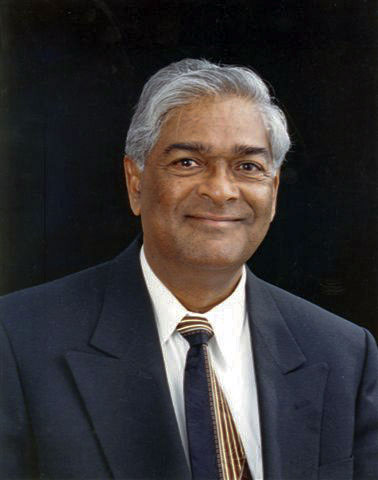 Dr. Sanjaya Rajaram was born on a small farm in rural Uttar Pradesh, India, in 1943. Unlike most children in his socioeconomic position, he was encouraged to pursue an education by his parents, and graduated from secondary school as the top-ranked student in the entire Varanasi District. Rajaram went on to earn a B.Sc. in agriculture from the University of Gorakhpur, a M.Sc. in genetics and plant breeding from the Indian Agricultural Research Institute in New Delhi and a Ph.D. in plant breeding from the University of Sydney. Rajaram’s outstanding career at CIMMYT began in 1969 working as a wheat breeder alongside Dr. Norman Borlaug. In 1972, at the age of 29, Borlaug appointed him as head of CIMMYT’s Wheat Breeding Program. After 33 years at CIMMYT, including seven as Director of the Global Wheat Program, Rajaram joined the International Center for Agricultural Research in the Dry Areas (ICARDA) as Director of Integrated Gene Management before formally retiring in 2008. During his distinguished career, Rajaram’s work resulted in the release of more than 480 varieties of bread wheat in 51 countries, which are grown on more than 58 million hectares worldwide. Rajaram is a Mexican citizen and resides in Mexico.