Drought tolerant wheat in Kazakhstan
“This year has been terrible for wheat production,” said Yuriy Zelenskiy, CIMMYT wheat breeder in Kazakhstan. “Since planting, there have been 60 days without rain, and the temperature has been on average between three and five degrees higher than normal,” he added. Drought and heat-tolerant wheat varieties were among the major topics during the 10th International Meeting at the Kazakhstan-Siberian Network on Wheat Improvement (KASIB) held during 6-9 August 2012 at Kostanay and Karabalyk Agricultural Experimental Station in Kazakhstan. The meeting was attended by 35 leading breeders and agricultural specialists from Kazakhstan and Russia, as well as experts from CIMMYT, JSC “KazAgroInnovation”, and representatives of the Ministry of Agriculture of Kazakhstan.
KASIB was established by CIMMYT in 2000 to foster international collaboration in the region. The network currently includes 19 breeding programs in Kazakhstan and Russia, representing an area of over 20 million hectares of spring wheat production. Each of the breeding programs provides three lines for testing by each partner, and the 50 best lines are then selected and distributed throughout the network to increase efficiency and speed up the process of wheat breeding.
Kazakhstan is among the top ten wheat producers in the world. This year, the crop was sown on 16 million hectares, though it was estimated that over 7 thousand hectares of wheat were destroyed as a result of severe drought. Kazakhstan’s grain harvest is expected to reach 14 million tons, 50% less than last year. While this output is still above the yearly average (about 13 million tons), last year’s record yield of almost 23 million tons showed the potential with the use of drought-tolerant wheat varieties. The situation is similar in the rest of the region: wheat production in Russia, Ukraine, and Kazakhstan is estimated to be 30% less than 2011 yields.
Over 15,000 lines have been exchanged and tested through KASIB network since its inception. KASIB materials are tested for 20 traits, such as resistance to diseases and drought and heat tolerance, and include high-yielding varieties best suited for this agro-ecological zone. “This kind of international cooperation is the best way to introduce new varieties,” stated Muratbek Karabayev, CIMMYT representative in Kazakhstan.
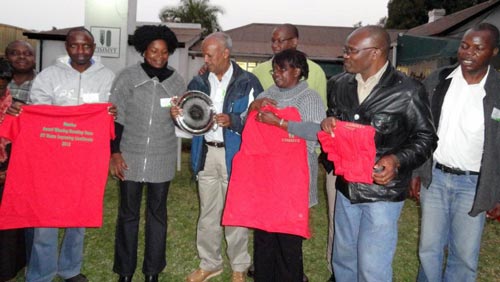 Maize plays a pivotal role in the livelihoods of people in southern Africa: its annual per capita consumption is around 85 kg. In the past season, however, farmers in Angola, Botswana, Lesotho, Swaziland, and much of Zimbabwe experienced a severe drought that significantly reduced their harvests.
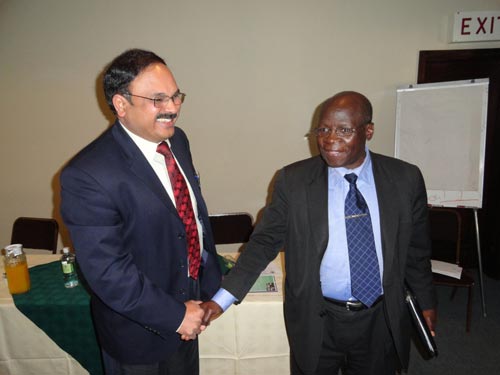 Participants discussed some of their notable achievements from 2011-12. Angola began its first commercial-scale production of the drought tolerant hybrid seed with Agropequária Kambondo and produced significant quantities of the drought tolerant openpollinated variety (OPV) ZM523. Farmers in the Democratic Republic of the Congo produced 80 tons of the drought tolerant OPV ZM623 through community-based seed schemes. Lesotho released a quality protein maize variety, and Zambia’s national program made significant progress in breeding for drought tolerance. Local emerging seed companies in Mozambique have begun production of one drought tolerant OPV and three drought tolerant hybrids.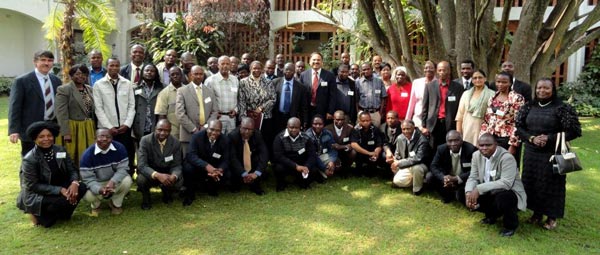
 On 1 and 2 August 2012, representatives of public and private organizations interested in developing information technologies for the agricultural sector met at CIMMYT to participate in the MasAgro Movil Think Tank.
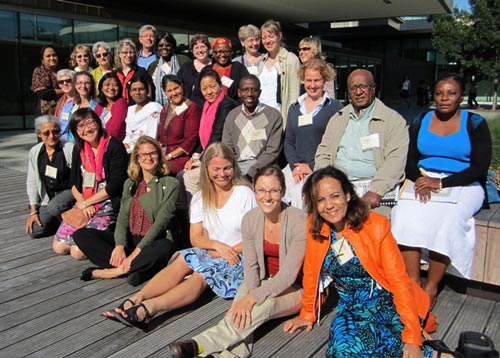 “The workshop was a great opportunity to share ideas and lessons learned, to exchange concepts of different gender strategies, as well as to discuss the latest gender-related research methods,” said Beuchelt. The workshop identified four themes for cross-program research on gender and agriculture: (1) engendering agricultural value chains; (2) gender-transformative approaches; (3) gender and technology adoption and diffusion; and (4) gender and nutrition. The participants also agreed upon a shared set of gender-responsive research outcomes that can be jointly monitored to assess progress towards CGIAR System Level Outcomes. Furthermore, they discussed how to measure these outcomes and agreed to continue collaboration on the development and measurement of a shared set of genderresponsive indicators.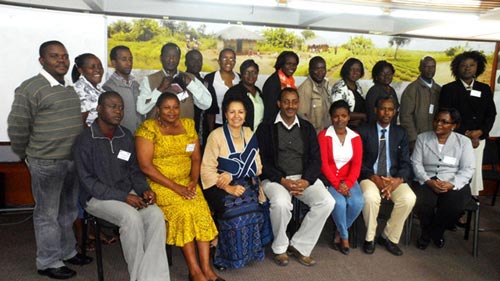
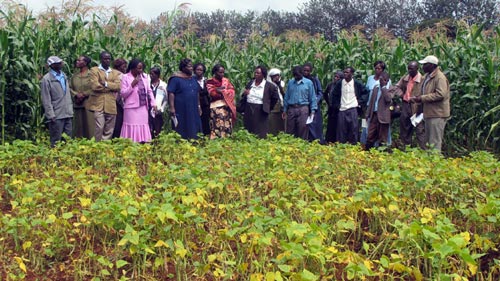
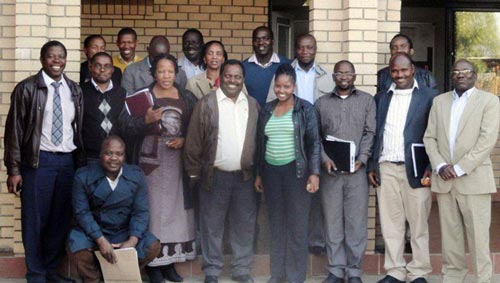
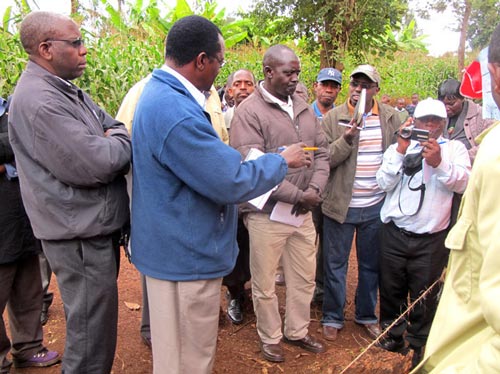 A delegation of scientists from South Sudan, Rwanda, and Uganda —the spillover countries of the Sustainable Intensification of Maize-Legume Systems for Food Security in Eastern and Southern Africa (SIMLESA) initiative— visited Embu, Kenya, during 18-20 July 2012, to gain hands-on experience in implementing the program and to learn about its impact on livelihoods of smallholder farmers.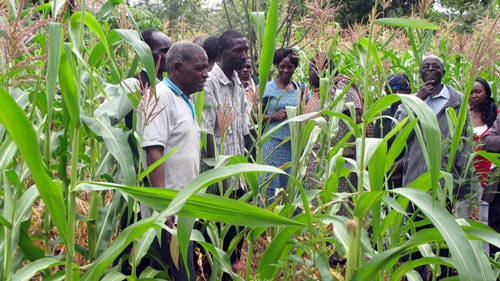
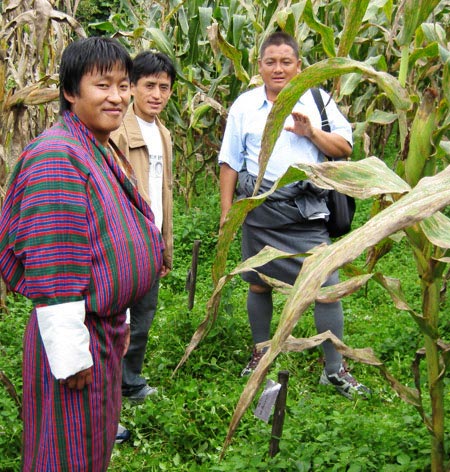 Maize is one of the major staples in Bhutan and is cultivated by about 70 percent of households throughout the country. Poor farmers sustain their families by consuming maize as a staple food, using it as animal feed, and selling it for further income. Thus, the 2007 outbreak of Gray Leaf Spot (GLS), a new disease caused by Cercospora zeae-maydis, posed a major challenge to the Bhutanese maize program and maize farmers, many of whom lost over 70 percent of their production.
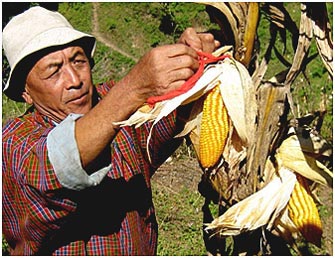 The replacement of seeds has been facilitated through Community Based Seed Producers (CBSP) groups. In 2011 and 2012, over eight tons of seed was supplied to GLS-affected farmers in 10 districts. The average yield recorded under farmers management was 3.73 t/ ha for S03TLYQAB05, and 4.43 t/ ha for ICAV305. Production of basic and foundation seeds has started at research farms and will serve as seed source for the CBSP groups. By 2013, the National Maize Program aims to replace 80 percent of the seeds for GLSaffected farmers cultivating maize above 1,500 masl. The program cooperates with the National Seed Center and CBSP groups to achieve higher efficiency in seed replacement.
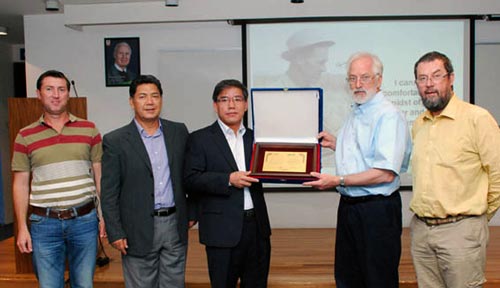 RDA is a central government organization responsible for agricultural research and services. Since its foundation, it has helped South Korea to achieve self-sufficiency in rice and other staple food production through dissemination and promotion of high-yielding cultivars and improved cropping technologies, and contributed to the improvement of the rural environment.